



Summary: Checking your brake pads does not require a lift, special tools, or a mechanical background. With a flashlight and about five minutes, you can assess your Hyundai’s brake pad condition and know whether you are well inside the safe zone, approaching the replacement threshold, or past it. At McCarthy Hyundai of Lawrence, this is the practical guide every Hyundai driver in Lawrence and northeast Kansas should know.
Why Checking Your Brakes Yourself Actually Matters
Most drivers wait for a noise before thinking about their brakes. That approach works, eventually, but it means you are relying on a warning system designed to alert you when pads are already near the end of their life. A quick visual check every few months catches wear earlier, lets you plan service on your schedule rather than reactively, and confirms what your service technician tells you at your next visit.
It also gives you a reference point. A driver who has seen their own brake pads at 8mm, then again at 5mm, then again at 3mm, has a much better sense of how fast their pads are wearing and when service is actually needed. That knowledge is worth having.
According to Hyundai USA, the recommended frequency for brake inspection is every 7,500 miles or with every tire rotation, roughly every six months. Between professional inspections, a monthly visual check through the wheel spokes takes less time than checking your tire pressure and gives you valuable information about one of your vehicle’s most critical safety systems.
Understanding What You Are Looking At
Before you get down next to the wheel, it helps to understand the basic anatomy of what you will see so you know what each component is and what healthy versus worn looks like.
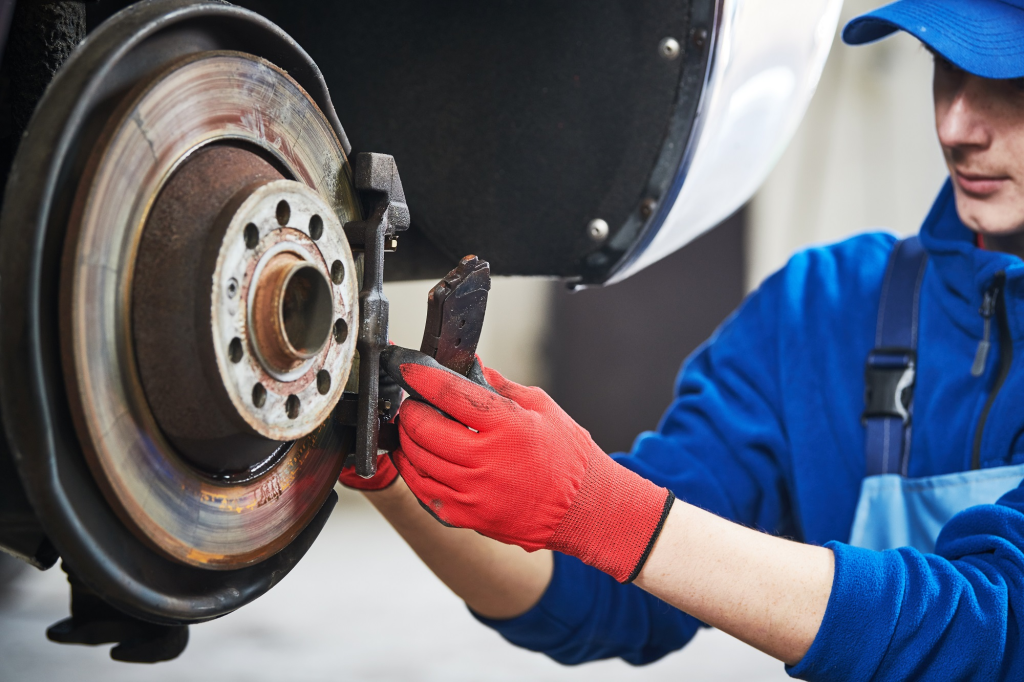
Behind your Hyundai’s wheel, you will see a large metal disc: that is the brake rotor. Clamped around the rotor is the brake caliper, a metal housing that contains the brake pads on both sides of the rotor. When you press the brake pedal, hydraulic pressure pushes the pads inward to clamp the rotor and create friction.
The brake pad itself consists of two parts: the friction material, which is the dark, textured surface that contacts the rotor, and the steel backing plate behind it, which is the structural base. The friction material is what wears down with every brake application. When it wears through to the backing plate, metal contacts metal, the rotor is damaged immediately, and braking performance drops sharply.
A new Hyundai brake pad starts with approximately 12mm of friction material. The replacement threshold specified by Hyundai USA is 3mm. Everything between 12mm and 3mm is the usable service life of the pad. Your job during a visual inspection is to estimate where in that range your pads currently sit.
Method 1: Checking Brake Pads Through the Wheel Spokes
This is the fastest method and requires no tools beyond a flashlight. It works on most Hyundai models with alloy wheels that have open spoke designs, which covers the majority of current Tucson, Santa Fe, Elantra, Palisade, Sonata, and IONIQ models.
Step 1: Park Safely and Prepare
Park your Hyundai on a flat, level surface and engage the parking brake. Turn the engine off. If the vehicle has been recently driven, the rotors will be warm: this is fine for a visual inspection since you are not touching anything, but be aware that metal components get hot during braking.
Step 2: Turn the Steering Wheel for Better Visibility
On the front wheels, turning the steering wheel fully to one side before you step out dramatically improves visibility of the brake components behind that wheel. Turn the wheel fully to the right to get the best view of the driver’s side front brake, then left for the passenger side front brake. Rear brakes are visible without this step.
Step 3: Crouch Down and Look Through the Spokes
Position yourself at wheel height and look through the wheel spokes toward the caliper assembly. Use your flashlight to illuminate the area, particularly if you are in a garage or low-light environment. You are looking for the brake pad pressed against the face of the rotor.
Step 4: Assess the Friction Material Thickness
What you are looking for is the amount of dark friction material visible between the rotor surface and the steel backing plate. Here is what each observation means in practice:
- Thick, uniform dark material (looks like more than half an inch): You are well within the safe zone. Pads are likely 7mm or more. No action needed.
- Moderate friction material (looks like roughly a quarter inch): Pads are in the 4 to 6mm range. Approaching the replacement window but not urgent. Plan service within a few months and mention it at your next oil change.
- Thin material (looks like 3mm or less, approaching the backing plate): You are at or near the Hyundai replacement threshold. Schedule service promptly.
- No visible friction material, backing plate appears to contact the rotor: This is the metal-on-metal stage. Do not delay. Service is needed immediately.
Step 5: Check the Wear Indicator Slot
Many Hyundai brake pads have a center slot or groove machined into the friction material that serves as a visual wear indicator. When new, this slot is clearly visible as a channel running across the pad face. As the pad wears toward its replacement threshold, the slot becomes shallower and eventually disappears. If you can see the slot clearly, you have remaining pad life. If the slot is difficult to see or gone entirely, you are approaching the replacement threshold.
Step 6: Repeat for All Four Wheels
Front and rear brake pads wear at significantly different rates. Front brakes perform approximately 70 percent of the total stopping work because forward momentum transfers weight to the front during braking, increasing the load on the front pads. This means front pads typically wear two to three times faster than rear pads on the same vehicle. Always check all four corners rather than assuming the rears are fine because the fronts look good.
Method 2: Checking Brake Pads With the Wheel Removed
If your Hyundai has wheels that do not allow a clear view through the spokes, or if you want a fully unobstructed inspection with precise measurement capability, removing the wheel gives you complete access to the entire brake assembly.
What You Will Need
- A floor jack and jack stands
- Lug wrench or breaker bar with the correct socket for your Hyundai’s lug nuts
- Flashlight
- Wheel chocks for the opposite axle
- Optionally, a digital caliper for precise measurement
The Process
Place wheel chocks behind the rear wheels if working on the front, or in front of the front wheels if working on the rear. Loosen the lug nuts slightly while the wheel is still on the ground to prevent it from spinning. Position the floor jack under the vehicle frame at the designated jacking point for your model (refer to your owner’s manual for the correct location) and raise the vehicle. Support it on jack stands before removing the wheel. Never work under a vehicle supported only by a floor jack.
Remove the lug nuts and wheel. With the wheel off, you have a clear, unobstructed view of the entire brake assembly including both the outer and inner brake pads, the full rotor surface, the caliper, and the brake lines. The outer pad is the one you could partially see through the spokes. The inner pad faces the wheel hub and is only visible with the wheel removed.
The inner pad is important to check because calipers occasionally develop a sticking piston that causes the inner pad to wear significantly faster than the outer pad. If you only ever check the outer pad, a prematurely worn inner pad can go undetected until serious rotor damage occurs.
Use your flashlight to assess friction material thickness on both pads. If you have a digital caliper, you can measure the exposed pad thickness directly. Anything below 3mm friction material thickness is at or past Hyundai’s replacement specification. Anything in the 3 to 4mm range is the replacement window. Anything above 6mm is still in the comfortable service life range.
While the wheel is off, also look at the rotor surface. A healthy rotor has a smooth, lightly shiny appearance. Visible grooves or scoring in the rotor face, a raised rust ridge at the outer edge of the rotor where no pad contact occurs, or deep rust pitting indicates the rotor’s condition needs professional evaluation at your next service visit.
Warning Signs to Listen and Feel for Between Visual Checks
Visual inspection gives you the clearest picture of pad condition, but your Hyundai also communicates brake wear through sound and feel. Understanding the progression of these signals helps you respond at the right time:
Squealing When Braking
This is the designed early warning system. A small metal wear indicator tab is built into Hyundai brake pads and begins contacting the rotor surface when pads approach the 3mm threshold. The resulting high-pitched squeal is intentional: it is the brake system telling you service is due. You can still drive to a service appointment, but do not ignore it or delay. The sound is telling you something specific and accurate.
Note that new brake pads occasionally squeal briefly during the first few hundred miles of use, and pads can also squeal temporarily after sitting overnight in damp conditions. The wear indicator squeal is persistent, occurs every time you brake, and does not go away after a few minutes of driving.
Grinding Metal-on-Metal Sound
If the squealing stage was ignored, the next sound is grinding. This means the friction material is gone and the steel backing plate is contacting the rotor directly with every brake application. Rotor damage is active and immediate. Do not continue driving normally. Drive carefully directly to service or arrange towing.
Pulsation or Vibration Through the Brake Pedal
A pedal that pulsates or vibrates during braking indicates an uneven rotor surface rather than a tire balance issue. This can result from heat-warped rotors or from uneven pad material transfer onto the rotor face from delayed pad replacement. Either way it is a brake system issue that needs professional diagnosis and should not be confused with steering wheel shimmy from wheel balance problems, which is felt at speed without braking.
Vehicle Pulling to One Side While Braking
If your Hyundai pulls left or right under braking, one brake is applying more force than the other. This usually means uneven pad wear, a sticking caliper piston on one side, or a brake fluid flow restriction. It is a safety issue that needs diagnosis rather than simply replacing pads on both sides without finding the root cause.
Brake Warning Light
Hyundai models equipped with electronic brake pad wear sensors will illuminate a dashboard warning light when pads reach minimum thickness. Not all trim levels include this sensor, and it is a last-resort alert rather than an early warning system. If the light comes on, service is overdue rather than approaching. Some Hyundai models use the same warning light for both pad wear and low brake fluid level, which is why any brake warning light illumination warrants prompt inspection rather than simply checking pad thickness.
The Brake Pad Wear Progression: A Quick Reference
| Pad Thickness | Condition | Action |
|---|---|---|
| 10 to 12mm | New or nearly new | No action needed. Check again at next rotation. |
| 6 to 9mm | Normal service wear | No action needed. Monitor at each inspection. |
| 4 to 5mm | Approaching replacement window | Plan service within 1 to 2 months. Mention at next oil change. |
| 3 to 4mm | Replacement threshold per Hyundai USA | Schedule service promptly. Squealing likely starting soon. |
| Below 3mm | Past replacement specification | Service needed immediately. Rotor damage risk is high. |
| Backing plate visible | Metal-on-metal contact | Do not delay. Drive carefully to service center or tow. |
What Happens at a Professional Brake Inspection at McCarthy Hyundai of Lawrence
A DIY visual check gives you a useful general picture, but it has limitations. You can estimate thickness and spot obvious wear, but you cannot precisely measure both inner and outer pad thickness simultaneously, assess rotor surface finish and minimum thickness, evaluate caliper piston movement and seal condition, test brake fluid moisture content, or check brake line integrity. A professional inspection covers all of these.
At McCarthy Hyundai of Lawrence, our certified technicians measure pad thickness with precision tools on all four corners, compare rotor thickness to the manufacturer’s minimum specification for your specific Hyundai model, assess caliper function, check brake fluid condition and moisture content, and inspect brake lines for any signs of corrosion or wear. You get a complete picture rather than a partial one, and every measurement is documented in your service record.
Hyundai recommends this comprehensive inspection every 7,500 miles or with every tire rotation. We include it automatically at every oil change service, which means if you are staying on schedule with oil changes at McCarthy, your brakes are being professionally assessed approximately every six months without any additional appointment needed.
Key Takeaways: Checking Your Hyundai Brake Pads
- ✅ New Hyundai brake pads start at approximately 12mm. Hyundai USA specifies replacement before pads wear below 3mm.
- ✅ Visual inspection through the wheel spokes takes about five minutes and requires only a flashlight.
- ✅ Check all four wheels, not just the front, since inner pads and rear pads can wear differently than outer and front pads.
- ✅ Squealing during braking is the designed wear indicator alert and signals pads are near the 3mm threshold. Grinding means the friction material is gone.
- ✅ Pedal pulsation is a rotor issue, not a pad wear symptom alone, and needs professional diagnosis.
- ✅ Hyundai recommends professional brake inspection every 7,500 miles, which our team performs automatically at every oil change.
Why Choose McCarthy Hyundai of Lawrence for Brake Service?
When your visual inspection reveals pads approaching the replacement threshold, or when you hear or feel any of the warning signs described above, the next step is a professional inspection and service at McCarthy Hyundai of Lawrence:
- Factory-Certified Hyundai Technicians: Our team knows the exact pad and rotor specifications for every Hyundai model and measures precisely rather than estimating visually.
- Brake Inspection at Every Oil Change: Included automatically. You never need a separate appointment to know where your brakes stand.
- Genuine OEM Brake Pads and Rotors: Every replacement uses Hyundai-approved components that match your vehicle’s original friction specifications and protect your warranty.
- Honest, Documented Recommendations: We give you the actual measurements and let you decide. No pressure, no exaggeration.
- 4.5-Star Google Rating with Nearly 1,500 Reviews: Our service reputation reflects years of straightforward, accurate work for the Lawrence community.
- Easy Online Scheduling: Book your service appointment online any time, 24 hours a day.
- Convenient Lawrence Location: Find us at 2829 Iowa St, Lawrence, KS 66047. Call us at (785) 838-2327 with any questions.
Conclusion: Five Minutes That Can Save Your Rotors and Your Safety
Brake pad inspection is one of the simplest, most accessible maintenance habits a driver can develop. You do not need a lift or a shop. You need a flashlight, a few minutes, and the knowledge of what you are looking for. The habit of checking your Hyundai’s pads every couple of months, combined with professional inspection at every oil change, gives you complete visibility on one of the most safety-critical systems in your vehicle.
When it is time for service, our certified team at McCarthy Hyundai of Lawrence is here with the expertise, the right parts, and the honest approach that keeps your Hyundai’s brakes exactly where they need to be.
📍 Visit us: 2829 Iowa St, Lawrence, KS 66047
📞 Call us: (785) 838-2327
🔧 Schedule a brake inspection online | Explore our service center
Frequently Asked Questions: Checking Hyundai Brake Pads
How do I check my Hyundai brake pads without removing the wheels?
Look through the wheel spokes toward the brake caliper assembly using a flashlight. You should be able to see the brake pad pressed against the rotor face. Assess the thickness of the dark friction material visible between the rotor and the steel backing plate. On the front wheels, turning the steering wheel fully to one side before stepping out improves visibility significantly. If the friction material looks very thin or you cannot see it clearly, remove the wheel for a closer inspection.
What thickness means my Hyundai brake pads need replacing?
Hyundai USA specifies replacing brake pads before they wear below 3mm of friction material. New pads start at approximately 12mm. At 3 to 4mm, symptoms like squealing from the wear indicator typically begin. Below 3mm, you are past the replacement specification and risk damaging the rotors. Above 6mm, you are in the comfortable portion of the service life range.
What does brake pad squealing mean on my Hyundai?
Squealing during braking is usually the wear indicator tab, a small metal component built into the brake pad, making contact with the rotor. This is an intentional warning that friction material is approaching the 3mm replacement threshold. You can drive to a scheduled service appointment, but do not delay. A grinding sound indicates the friction material is gone entirely and the steel backing plate is contacting the rotor, which requires immediate service.
Why do I need to check all four wheels?
Front and rear brakes wear at significantly different rates since the front brakes perform approximately 70 percent of the total stopping work. Front pads typically wear two to three times faster than rear pads. Additionally, inner and outer pads on the same axle can wear at different rates if a caliper piston is sticking. Checking all four corners gives you the complete picture that a single quick glance at one wheel cannot provide.
How often does Hyundai recommend brake inspection?
Hyundai recommends brake inspection every 7,500 miles or with every tire rotation, approximately every six months under normal driving conditions. McCarthy Hyundai of Lawrence includes brake inspection automatically at every oil change service, meaning drivers on our standard maintenance schedule have their brakes professionally assessed approximately twice a year without any additional scheduling required.
How do I schedule a brake inspection at McCarthy Hyundai of Lawrence?
Use our online service scheduler available 24 hours a day, call us at (785) 838-2327, or visit us at 2829 Iowa St, Lawrence, KS 66047. A comprehensive brake inspection is included with every oil change appointment automatically.

